I touched on the background of this app briefly in the previous blog post, but I'd like to go deeper here. Though the domains differ greatly, I found a striking commonality between my own experience and a story from a college friend — and it made me feel that the underlying challenge is universal.
Why I Built NASEBANAL Recorder — A Personal Need for Versatile Data Management
As I mentioned in the previous post, one key characteristic I envision for this app is "versatility." Let me share the background behind that thinking.
I studied information science in college and have spent my career in the IT industry. For a long time, I'd had a lingering desire: "Someday I'd like to experience life in Silicon Valley. Companies like Google emerge from there — what makes it different from Japan?" I read books like *Regional Advantage* (known in Japan as "現代の二都物語") and *Venture's Infrastructure*, and while I sensed that the ecosystem supporting startups must be fundamentally different, I wanted to see it with my own eyes. That's why, even as a working professional, I set my sights on studying at a university near Silicon Valley — and kept studying English, a prerequisite for that goal, alongside my job.
But raising my TOEFL score turned out to be harder than I expected. I told myself, "If I just put in enough hours, my score will eventually go up. A low score just means I haven't studied enough." So I squeezed in study time — before work, during lunch, after the office. My score improved somewhat, but then hit a plateau. Across multiple tests, I consistently did well on Reading, but Listening in particular barely budged.
Looking back, I realize that while studying in the margins of a busy work life, I ended up spending too much time on what was easy and comfortable rather than what was needed. Specifically, I gravitated toward vocabulary memorization and reading — things I could squeeze into spare moments and that felt pleasant to do. But to maximize my score efficiently with limited time, I should have confronted my weak areas head-on and devoted more time to improving them. It took me a while to realize this.
Some time into my career, I had a conversation with a college friend that gave me a similar insight. He had been a serious tennis player since childhood, and what he told me was striking: "There was a time in college when I hit a slump in tennis. Back then, I thought just running more would make me better, so I did a lot of running drills. But to truly improve, I realized I needed to structurally analyze my weaknesses and address each one systematically." My English study had been exactly the same. And it led me to think that there is a rational path to improvement — not necessarily a shortcut, but a structured one — and this is precisely where experienced coaches and trainers add real value.
Growing and developing people follows a universal process:
- Set goals at an appropriate level
- Break down challenges structurally
- Design effective training for each sub-goal
- Track (visualize) progress and course-correct as needed
- Build up small successes to maintain motivation, then take on bigger challenges
I believe that Shohei Ohtani's success in Major League Baseball and Sota Fujii's dominance in shogi both stem from high intrinsic motivation combined with an ability to run this cycle effectively — reaching heights that others can't.
NASEBANAL Recorder was built on this philosophy of "developing people" — think of it as a foundational tool for collecting data and managing progress. In the future, I aim to build higher-level (multi-layered) goal management and training plan features on top of Recorder, as well as expand automated metric collection tools for areas where manual tracking is impractical.
There may already be excellent domain-specific tools in the market — blood pressure trackers, TOEFL score managers, and so on. But when data is scattered across separate tools, you lose the synergy of combining multiple data streams to uncover new insights. And personally, I don't want to keep installing domain-specific apps on my phone and learning each one's interface. Then again, I don't want to manage data in Excel on my phone and share it with others that way either.
That's the motivation behind building NASEBANAL Recorder.
Our Approach to Personal Data Protection
When building a data management service, addressing security is absolutely essential. Sensitive information leaking to unauthorized parties would be a serious problem. We took two key actions:
- A Secure by Design service built entirely on Cloudflare's stack
- A data management approach applying the concept of "Tokenization"
First, the service is built to fully leverage Cloudflare's stack. As a result, DDoS attacks are blocked by default, and major security risks are mitigated through Cloudflare WAF's managed rules.
However, even with these protections, if a user's password is compromised on their end, there are limits to what server-side security can do. This led us to think: "We must continue our best efforts to prevent data leaks, but even if data were to leak, it would be fine as long as the data's meaning remains opaque."
This concept draws on the principles of "Tokenization," a widely used technique in data security. In Tokenization, sensitive data such as credit card numbers is replaced with tokens — substitute values that have no intrinsic meaning. The tokens cannot be reverse-engineered back to the original data; the mapping is strictly managed within the tokenization system. Even if tokenized data is leaked, the sensitive information remains inaccessible.
The key insight was: "What if the *meaning* of the data is something only the user knows in the first place — making a tokenization system unnecessary?" This may sound simple, but most services need to understand the meaning of your data in order to provide advanced analytics, so few are designed with this philosophy in mind.
NASEBANAL Recorder is a platform purely for managing data, visualizing it as graphs, and sharing it with relevant parties. Of course, if you want to share your achievements publicly, you can use descriptive tag names and add explanatory comments on your SNS sharing page. But if "private data management" is your goal, you can take a Tokenization-inspired approach — splitting data across multiple separate sets, or assigning arbitrary strings to tag names (metadata) — to create a data management system that only you can interpret. With such a setup, even partial data leaks would be difficult for others to interpret.
What 2 Months of Weight Tracking Taught Me
With this vision in mind, I built NASEBANAL Recorder — partly as an exercise in serious app development using Claude Code — and started dogfooding it myself. Among the first things I tracked were my children's running times and my own body weight.
There's a scale at my gym. I'd step on it from time to time, glance at the number, and move on. I had a rough idea of my weight, but I never actually kept a detailed record.
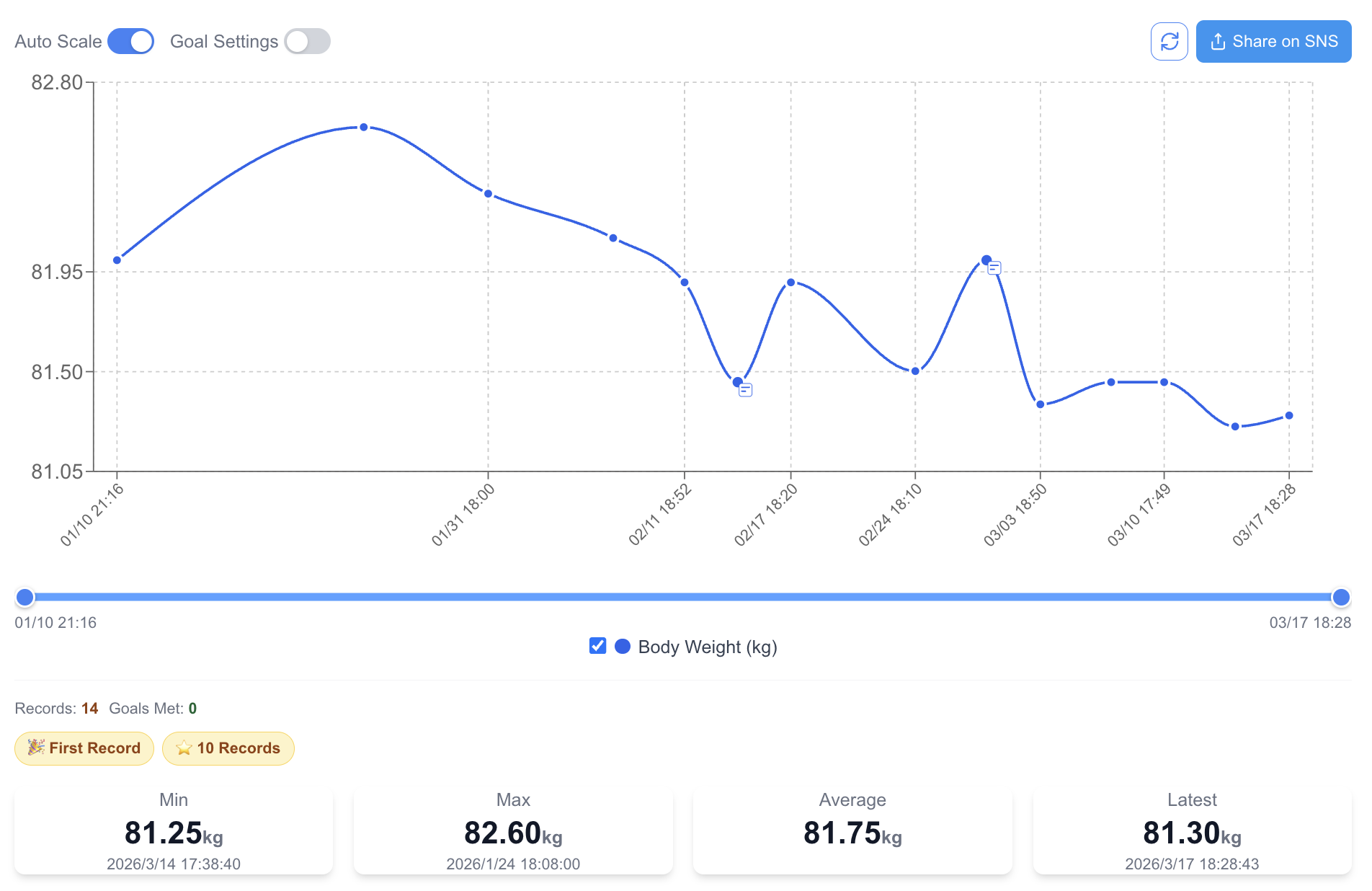
When I started logging my weight consistently with NASEBANAL Recorder, patterns I'd never noticed began to emerge. I'd always *felt* like I gained weight over the New Year holiday — but I hadn't grasped how much it fluctuated day to day or over what time intervals. Once I started recording, I found that even changes of just a few hundred grams brought all kinds of insights. When the numbers crept up even slightly, I'd think, "Come to think of it, I have been eating a bit more lately." And when I made small, conscious adjustments to my diet, I could see the weight steadily come down — a few hundred grams at a time — over the following weeks.
Timing matters too. Weighing yourself right after eating or drinking will spike the number, and vice versa. So measuring at a consistent time of day is key — and by recording regularly and managing it as data, I genuinely felt the trends become visible.
These micro-trends only become visible when you record and visualize your data. And that's not just true for body weight — there are countless areas in life where we don't track the numbers, and we're missing insights as a result.
Here is the actual weight trend graph:
Predefined Category Tags
A feature we added as a result of dogfooding is "predefined tags" — which automatically compute derived metrics from your raw data. As a starting point, we've implemented and released two categories that are also areas of personal interest: Health and Finance.
Note: As discussed above, if your goal is to keep your data completely opaque to others, using predefined categories may not align with that purpose, since category names reveal the data's meaning. Whether to use this feature is entirely up to you.
Health/BodyWeight
Select Health/BodyWeight as the category for your weight tag, and the following are generated automatically:
- Health/BodyWeight — Your weight converted to a standard unit (kg)
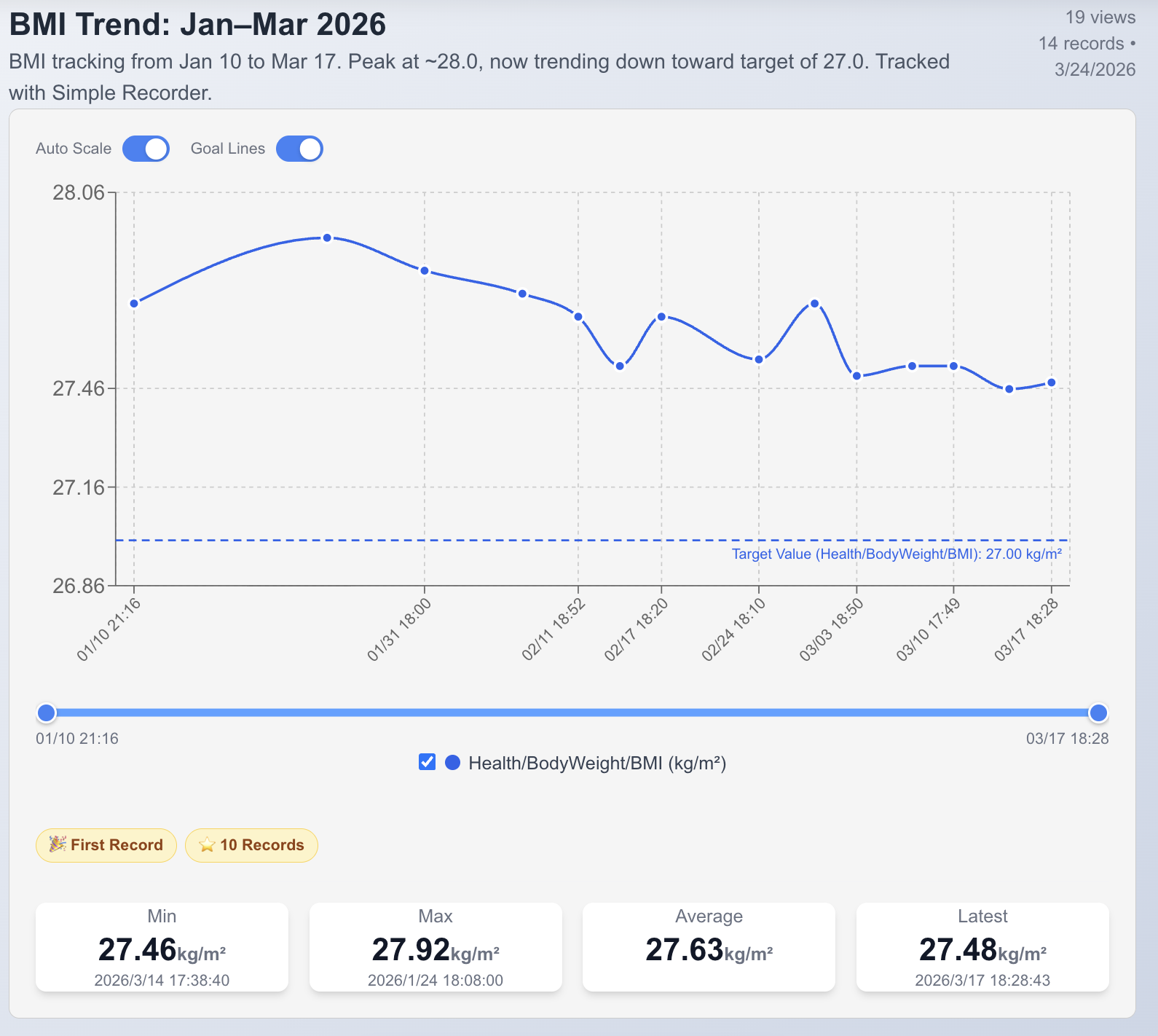
- Health/BodyWeight/BMI — BMI calculated from your weight and height
Since body weight is heavily influenced by height, BMI is widely used to assess whether your weight falls in a healthy range. Yet many people who know their weight can't tell you their BMI off the top of their head.
What constitutes an "ideal" BMI is debatable. A documentary I watched recently pointed out that muscle mass tends to decline with age, naturally bringing weight down — and suggested that a BMI around 27 may be a more appropriate benchmark for middle-aged and older adults.
With that in mind, we added automatic BMI calculation to NASEBANAL Recorder. Set a target value (e.g., BMI below 27), and a dashed goal line appears on your chart — letting you see both your daily progress and your target in a single view.
Finance/InvestmentAssets
The concept of FIRE (Financial Independence, Retire Early) has gained mainstream traction. More and more people are looking for ways to grow their savings and free themselves from work-related stress. But as long as you have a goal, tracking daily progress and making adjustments along the way is essential.
Select Finance/InvestmentAssets for an investment tracking tag, and the following are generated:
- Finance/InvestmentAssets — Your portfolio value in the selected currency (JPY, USD, EUR, GBP)
- Finance/InvestmentAssets/AnnualIncome — Projected annual income based on your expected return rate
This makes it easy to see at a glance how much more you need to accumulate. Set a target on your projected annual income, and you can watch the gap narrow day by day. Seeing steady progress toward your goal — even if it's gradual — can be a genuine source of motivation.
If you have ideas for predefined tags beyond these two, please let us know via Contact!
Other Features
The core philosophy behind our security approach is as described above, but there are a few additional policies we follow in building the app:
- No vendor lock-in — You can leave anytime. CSV import/export and API access are available, so your data always stays yours.
- API-first architecture — Similar to the approach used by Google Workspace, our architecture calls SSO-authenticated APIs from the frontend. As we add more services in the future, users can log in once via a shared session, and access data through PAT (Personal Access Token) — making it possible to call NASEBANAL Recorder's functionality from external applications as needed.
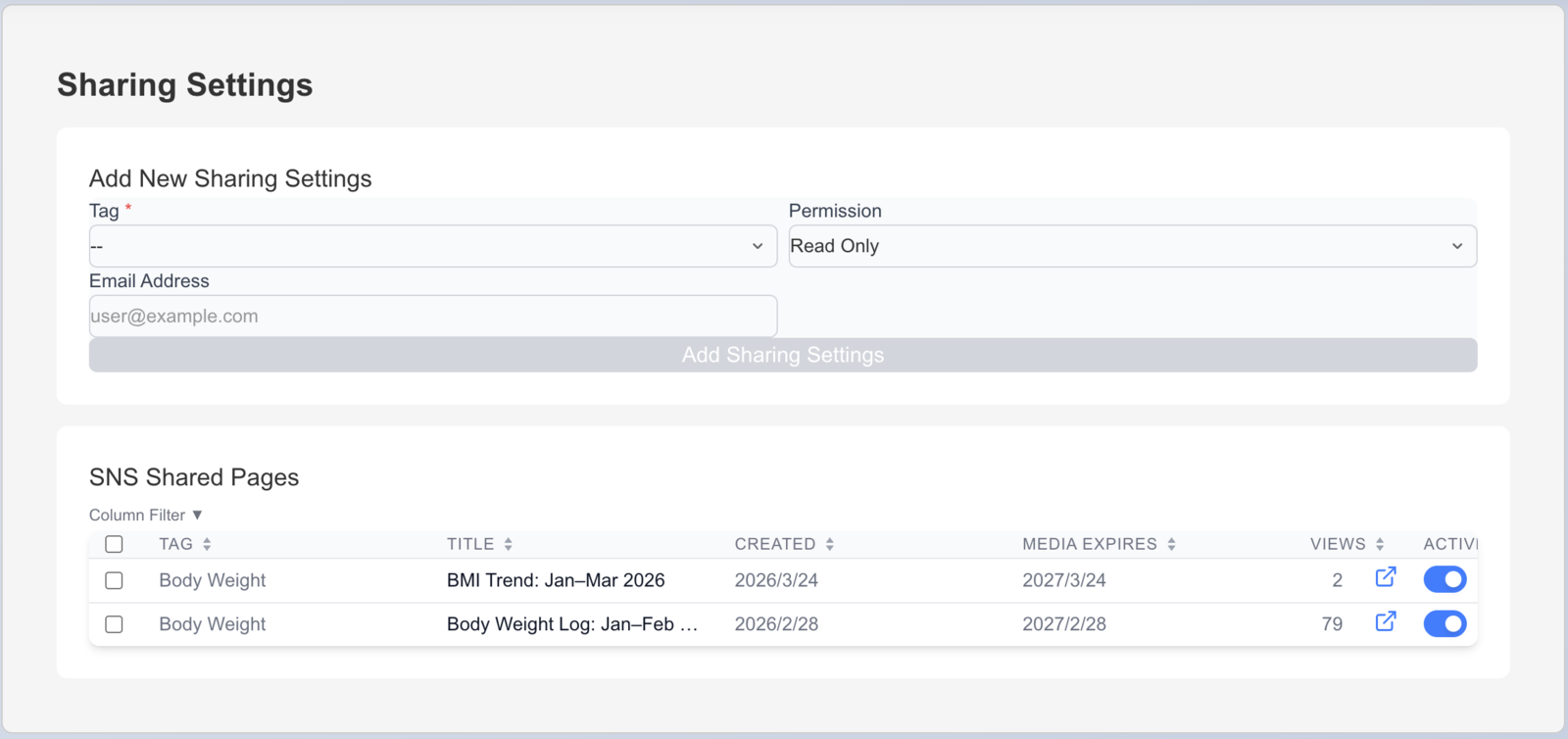
- Centralized sharing management & the "right to be forgotten" — Media files (images, audio) are shared via presigned URLs that automatically expire after a set period (1 year by default). SNS shared pages can be switched to private at any time, and you can check the view count for each shared page.
Try it yourself at recorder.nasebanal.com — it's free to get started. We're currently leveraging Cloudflare's free tier to keep the service free of charge for the time being.
If and when we introduce paid plans, we'll announce it in advance — and you can simply switch to the Free plan to avoid any charges. We'd love for you to give it a try and share your feedback!